22 October 2026 | Evershine Team | Buyers Guide
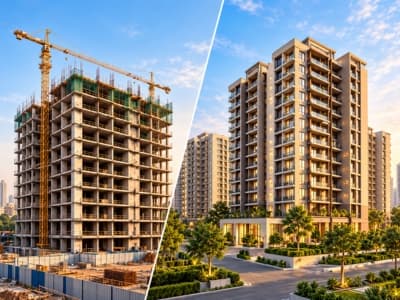
When you are evaluating flats in Mumbai, the choice between a ready-to-move unit and an under-construction one comes up early and stays with you through the entire decision process. Both options have genuine advantages. Both carry real risks. And the right answer depends heavily on your specific situation, not on which type is better in the abstract.
This post lays out what each option actually involves in 2026, what you pay, what you wait for, and which conditions tend to favour one over the other.
What Ready-to-Move Actually Means
A ready-to-move flat is one where the developer has received the Occupancy Certificate from the local authority. The OC signals that the building has been inspected, meets the sanctioned plan, and is legally fit for habitation. When you buy a flat after the OC has been issued, you are buying something you can move into, or rent out, without waiting.
This is a meaningful distinction. A flat that is physically complete but does not yet have the OC is not, in the regulatory sense, ready to move into. Buyers sometimes encounter this situation with projects that are close to completion. The building looks finished from the outside but the paperwork is still pending. In those cases, the GST treatment, the possession timeline, and the documentation involved are different from a genuinely post-OC unit.
Before treating any flat as ready-to-move, ask the developer for the OC and verify the date on it. If it has not been issued, you are effectively dealing with an under-construction purchase, regardless of how the project is described.
What Under-Construction Means for Your Costs
Under-construction flats attract GST. The current rates are 1% for units that qualify as affordable housing (carpet area up to 60 square metres in Mumbai and agreement value not exceeding Rs 45 lakh, both conditions required simultaneously) and 5% for all other residential units. Ready-to-move flats with a valid OC are exempt from GST entirely.
On a flat priced at Rs 1.2 crore, the 5% GST adds Rs 6 lakh to your outgoing. This amount is paid progressively across the payment schedule, not as a lump sum at the end. But it is real money, and it should be factored into your budget from the start, not discovered at the first payment demand.
Stamp duty and registration charges apply to both categories. These are state-level costs and are calculated on the agreement value or the government-assessed value, whichever is higher. The festive season occasionally brings limited-period stamp duty concessions on select under-construction units, but these do not affect the GST liability.
The Possession Risk in Under-Construction Projects
The most significant risk in buying under-construction is possession delay. This is not a fringe concern in Mumbai. Projects across the metropolitan region have histories of timelines extending beyond the originally committed dates, and buyers who made decisions based on a 2023 possession target and are still waiting in 2026 are not in an unusual situation.
MahaRERA has materially improved the accountability structure for developers. Every registered project now has a publicly accessible record showing the committed possession date, the promoter details, the approved plan, and quarterly updates. If a developer misses the RERA possession date, buyers have defined remedies under the Act, including the right to withdraw from the project with a refund and interest.
Before buying under-construction, look up the project on the MahaRERA portal. Check how many updates have been filed, whether possession timelines have already been revised, and what the developer's track record looks like on earlier completed projects. This takes an hour. It is the most useful hour you will spend in the purchase process.
The Financial Difference in How You Pay
Under-construction flats in Mumbai typically follow either a construction-linked payment plan or a time-linked one. In a construction-linked plan, your payments are tied to stages of the building: foundation, plinth, slab completions, and so on. In a time-linked plan, payments fall at fixed intervals regardless of what has been built.
Construction-linked plans are generally more buyer-friendly because your outgo is tied to actual progress. However, if the project slows, the payment schedule stretches, which has its own implications for your home loan and your rental situation in the interim.
Ready-to-move flats require full payment on or around possession, since there is no construction phase. If you are financing the purchase, your home loan begins disbursing on registration, and your EMI starts immediately. With under-construction, partial disbursements during construction mean the EMI builds up over time, which some buyers find easier to manage in the near term.
When Ready-to-Move Is the Stronger Choice
If your need to occupy is immediate or near-term, ready-to-move removes a category of uncertainty entirely. You can inspect the actual flat, not a sample unit. You pay what you pay, move in on schedule, and there is no construction risk to manage.
For buyers who are currently paying rent, the calculation is worth running carefully. Two or three years of rent during an under-construction wait, added to the 5% GST saving a ready-to-move unit offers, sometimes narrows or erases the price advantage that under-construction projects appear to carry.
Ready-to-move also works better for buyers who are less comfortable with documentation-heavy processes or who do not want to track a project through multiple construction stages and RERA filings.
When Under-Construction Makes Sense
Under-construction projects typically offer entry at a lower per-square-foot price than ready-to-move inventory in the same location. For buyers who can absorb the wait, the price difference can be meaningful, particularly in corridors where values have risen steadily as infrastructure projects have come in.
If you are not under immediate pressure to move, have a stable rental situation during the construction period, and are buying in a project from a developer with a clean RERA history, the under-construction route can be financially sound. The key discipline is doing the RERA research before booking, not after.
Under-construction also tends to offer more choice in terms of floor, unit configuration, and sometimes layout customisation in earlier stages. By the time a project is ready to move in, the best units in terms of view, floor, or orientation are often already sold.
About Evershine Builders
Evershine Builders has been developing residential projects across the Mumbai Metropolitan Region for over six decades. Projects span Virar, Kandivali, Santacruz, Khar West, and Bandra, across a range of unit sizes and price points.
Buyers evaluating under-construction options in 2026 can explore Evershine Amavi 303 in Virar and Evershine Bliss in Khar. Both projects are MahaRERA registered, with possession timelines and documentation clearly stated. To see all available projects, visit the Evershine project listings. To speak with the sales team directly, reach out here.
Frequently Asked Questions
1. Is there a GST difference between ready-to-move and under-construction flats in Mumbai?
Yes. Under-construction flats attract GST at 5% for non-affordable housing and 1% for units qualifying as affordable housing under the defined criteria. Ready-to-move flats for which an Occupancy Certificate has been issued are not subject to GST. This difference can amount to a significant sum on mid-range and premium units.
2. How do I confirm that a flat is genuinely ready-to-move and not just physically complete?
Ask the developer for the Occupancy Certificate and check the date of issue. A building that looks finished but does not yet have the OC is still treated as under-construction for regulatory and GST purposes. The OC is the document that determines the legal status of the unit.
3. What protections does MahaRERA provide for under-construction buyers in case of delay?
Under MahaRERA, developers must register projects and commit to possession dates publicly. If a developer misses the registered possession date, buyers are entitled to claim interest on the amounts paid for the period of delay, or to withdraw from the project and receive a refund with interest. These remedies are available through the MahaRERA authority and do not require the buyer to take the matter to civil court.
4. Does buying ready-to-move eliminate all risk?
Ready-to-move eliminates construction and possession timeline risk. However, buyers should still verify the OC, check that the unit matches the approved plan, review the society formation status, and confirm that all utility connections are in order. A title search and a lawyer's review of the sale agreement remain advisable even for ready-to-move purchases.
5. Can I negotiate more effectively on a ready-to-move flat or an under-construction one?
Negotiating room depends more on the project's inventory position than on its construction status. A developer with slow-moving ready-to-move inventory may offer more flexibility than one selling under-construction units in a fast-moving micro-market. In both cases, value additions such as parking upgrades, possession-linked incentives, or waived maintenance deposits are often more negotiable than the base price.

Established in 1960, Evershine Group has shaped a six-decade legacy of trust and excellence. Renowned for creating nature-inspired homes with modern amenities, we deliver more than promised, offering middle-income families an aspirational lifestyle. Our focus on quality, innovation, and customer satisfaction makes us one of Mumbai's most trusted real estate developers.
ADDRESS
215, 2nd Floor, Veena Beena Shopping Centre, Gurunanak Road, Bandra (West), Mumbai, Maharashtra 400050
© copyright reserved 2026
Privacy Policy


